Tuesday, 26 January 2021

Behavioural modeling

There you are, looking for a job, and one of the requirements is "experience in behavioural modeling".  What does that actually mean? 

The first thing to determine is what are behaviours.  Behaviours, or behaviors for the Americans among us, are easily understood but harder to define. Purely based on the linguistic definition, Oxford Languages says they are "the way in which one acts or conducts oneself, especially towards others" but also "the way in which an animal or person behaves in response to a particular situation or stimulus." Lee Alan Dugatkin agrees with the latter, formulating that "behavior is the coordinated responses of whole living organisms to internal and/or external stimuli." A behavior happens where there is a need "If an animal has a need, its motivational state is affected so that behavioral and physiological responses that should result in remedying that need can be made." (D. M. Broom).

It seems to me that behaviors are coordinated movements and acts, directed to addressing a need. Some behaviors are learned (styles of playing, replies to human commands), and some are inherited (searching for a teat after birth). 

Now that we know about behaviors, let's see what are models? Modeling means to build models, abstract representations of complex truths. A model can be a simplification, and can fit to all instances of a repeating concept. A model can be used to compare representations across species or in time.  Schank, Joshi and May write that "Models can be physical, symbolic, mathematical, or computational, but they are always simpler than the animal systems they represent." Clearly then there are several methods of modelling, and the best fit can be chosen based on the goal of the research. If we intend to use behavioral data in a computer system, a mathematical or computational description would seem the most suitable. If we intend to demonstrate the behavior to others or even mimic it, physical modelling is the way to go.  

Schank et. al. also give models nine dimensions:
  1. Realism
  2. Detail
  3. Generality
  4. Match
  5. Precision: how quantitatively precise a model is in it's predictions  
  6. Tractability: how analyzable or manipulable a model is
  7. Integration: Can it be used together with other models?
  8. Level: Cellular, population, strain...
  9. Medium
Let's take a look at some models to better understand how they really could look like.  The first example is a hidden Markov model (HMM) from the publication of Leos-Barajas, Gangloff, Adam et. al (2017).  This is a mathematical model. It looks complicated, and will require understanding about the mathematical notation and statistics to understand and to apply. 


Another beautiful example is from Ellen Evers from the University of Utrecht. In her presentation she explains the differences of Agent-based models (ABM) and Ordinary differential equations (ODE). 
An ABM looks at individuals: how each individual moves and acts during the behavior. It is less effective in modeling the group. An ODE looks at a group and determines the behavior of the group as a whole, losing sight of each individual. Her example uses the balance of wolves and sheep. Sheep are increased by births, and decreased by predation by wolves. Wolves are increased by predation, and decreased by natural death. 

In ODE terms the  models are
Sheep = + birth*Sheep – pred.*Sheep*Wolves  
Wolves = + pred.*Sheep*Wolves – death*Wolves

But for ABM the rules are for each individual:
SHEEP: If I meet wolve: die!
With chance = birthrate: Reproduce!

WOLVES: If I meet sheep: energy +1
If energy (from sheep) = 0: die!
With chance = birthrate: Reproduce

The big difference is that ODE model is deterministic. It can be used to predict situations when some variables are known. It could change what happens when there are 100 wolves and 50 sheep in comparison to a situation with 100 sheep and 50 wolves (in both cases, it's not looking good for the sheep.) ODE is not spatial (measuring things in terms of movements in space) and requires homogenity. ABM, on the other hand, just models the situation. It is applicable to heterogenous populations. 

I hope that this short introduction has given you some insight into modeling animal behavior. It is a complex field, and the lesson from Ellen Evers is heartily recommended as a good starting point for understand the differences of ABM and ODE.


More information

Lee Alan Dugatkin: What is "behavior", anyway?
Schank, Joshi, May et. al. Multi-modeling approach
Ellen Evers: ABM and ODE

Friday, 22 January 2021

Types of animal welfare studies

 When talking about animal experiments, it's easy to start thinking along the lines of mice, needles and electric shocks. But there are naturally a lot of other kinds of experiments as well. Consider a simple case where an animal is offered two kinds of food to see which one they choose first. That is also research on animals!

The study of animal welfare is a very complex field. Just to start with: what IS welfare and how to measure it when the animal itself cannot talk or describe it's emotional states? Obviously a complicated set of research methodologies is needed to achieve robust results. The measurements taken to achieve the results can be roughly divided into two: physiological and behavioral.

Physiological       Behavioral
Temperature
Heart rate
Blood glucose
Fat percentage
Weight
Bacterial count
Time spent sleeping
Frequency of a specific behavior
Posture changes
Social contacts
Time taken to approach objects
Distance traveled to forage

As you can see, welfare can actually be quite specific!

Next, let's have a look at some types of studies which are conducted to find out more about animal welfare. All of the measurements listed above are just data, but it's of course important to know how to gather the data to make sure - you guessed it - that the data is correct. So what kind of experiments are used?

Preference studies

Preference and motivation studies are both examples of empirical study, where the researcher gathers data on the target of their study. In preference studies the animals choose what they prefer and what factors influence the preference.

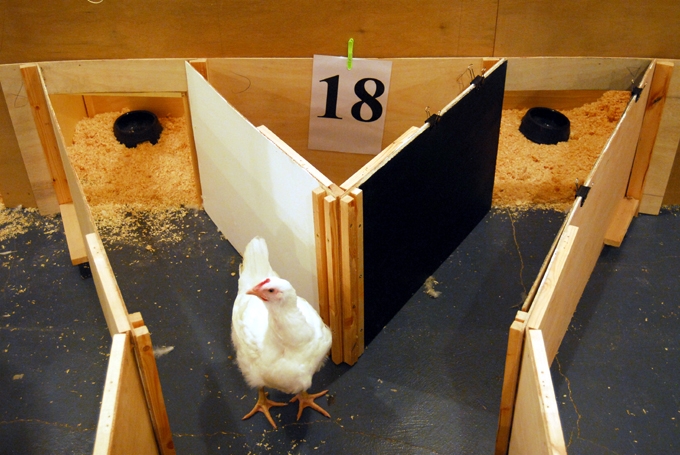
An example of preference study is to offer chickens feed with and without NSAIDs (painkillers). Chickens with healthy feet eat more of the feed without medication, while chickens with leg sores and ulcerations prefer the feed with the medication (self-medication). Factors affecting the preferences can be available time, diet, health and pregnancy.  

(c) Louse Buckley, UFAW

Motivation studies

Motivation study measures the motivation or willingness of an animal to reach a specific goal. The aim is to find out the value of things  and what impacts the motivation. For example, an animal might be very motivated to get a treat when alone, but less motivated when they're in a group and know they might need to share their treat. Measurements can be speed and distance traveled to the goal,  latency before the animal tries to reach the goal and energy spent to reach the goal.

In classic examples animal can be trained to press a lever to get a specific treat. Then the treat is disabled, and the amount of times the animal presses the lever trying to get the treat is the "price" they're willing to pay for it. Things like temperature, eating, health and group size can all affect the value of the reward. 

Metastudy

Metastudy is different from the other types, because this is the study of studies. In metastudies the researchers gather a vast amount of previous researches, carefully select the most relevant ones and summarize their findings. The process of selection and omission must naturally be well documented and argumented. The aim is to see wider trends and generalizations. Commonly seen phrases like "many studies prove" or "there is little scientific base on the claim that" arise from metastudies. Metastudy goes further than just being a literature review. It uses for example statistical methods to compare the results of the studies once comparativeness is established.   


More information:

Animal welfare science - Wikipedia

Consumer demand tests (animals) - Wikipedia


Wednesday, 28 August 2019

Dutch cattle breeds

Every country in the world has their own mix of cattle breeds which are used for the production of milk, beef, hide and other by-products. As extreme examples you could compare the barrel-chested, small and thick-furred Yakutian cattle of Russian Siberia to the slender, smooth-haired cows raised in Africa. Or think of the extremely demanding modern Holsteins with their exact dietary requirements and high milk yield, and their colleagues in developing lands who get by with the occasional tuft of grass, but produce only a fraction of the milk amount.


Today we'll look at the selection of the Netherlands. The Netherlands is a small country, but boasts a large selection of breeds used for milk, beef or both. Of course there are the well-known breeds like Holstein, Ayrshire, Brown Swiss and the tiny Jersey. They are mixed with some more exotic but just as interesting breeds, just read on!


Fleckvieh

This exotic name belongs to a very commonly used breed, which was established in 1920. It's known for it's udder health, longevity, calving ease and fertility. Originally the race is based on the Simmenthal, which still shows in the robust build and white head. The color is always red or white with red markings (red pied). Males are approximately 1200 kg and females 750 kg. Fleckvieh bulls can increase the health in milk production or serve as a basis for a beef herd.
(c) www.thecattlesite.com


Blaarkop

This dual-use breed is native to the Netherlands, and was established already in the 1400's. Blaarkop means literally "blister head" and gets it's name from the dark spots on it's otherwise white head. Like many native breeds they're slow in maturing, but very resilient and easy to handle. The bulls are about 800 kg and the cows 600 kg. It's known for the leg and hoof health as well as high protein count in the milk.


By Eadepoeltegroen, CC BY-SA 3.0

Lakenvelder (The Dutch belted)

This old Dutch breed is easy to recognize from it's color: it's black or white with a white belt in the middle. Lakenvelders are curious and trainable, and can be used for milk or beef production. Bulls can reach 900 kg, while cows stay at 450 -600 kg. It's well known for it's resilience, easy calvings and good meat quality.
By CattleLover - Own work, CC BY-SA 4.0


Mrij (Meuse Rhine Issel Cattle, MRI Cattle)

Another old Dutch breed, which has some impressive qualities: high protein content in the milk, easy calvings, excellent leg structure and high productivity! The name of this resilient cow is a combination from the two rivers in it's origins, Maas, Rijn en IJssel. Bulls can weigh a 1000 kg, while the cows stay at 670 kg, approximately. Did you know that when costs of milk production are counter per kilo of cow's weight, the mrij is more effective than the Holstein?


www.dairydreams.co.uk


Fries Roodbont (Friesian red)

The friendly red Friesian is from the northern part of Netherlands, in Dutch the Fryslân. They're used for milk production, and come from two separate lines: from the last original roodbont bull Vondeling 1 and from a cross of two Fries-Hollandse, who had red calves. It is equally fleshy, has healthy legs and hooves, and stands 130-145 cm high at the withers. This race almost died out when there was strong selection only for the black calves.
https://www.levendehave.nl/dierenwikis/runderen/fries-roodbont


Fries Hollandse

Yet another breed from the Fryslân. The original cattle, which survived from being mixed with Holstein cows into Holstein-Friesians, are smaller but wider than the Holstein-mixes. As many of the other original Dutch breeds also the compact Fries Hollandse is used for both meat and milk production.
https://www.levendehave.nl/dierenwikis/runderen/fries-hollands-vee


Sources

https://www.crv4all.nl
http://www.thecattlesite.com
http://www.wikipedia.com
https://www.levendehave.nl/
http://www.roodbontfriesvee.nl/


Tuesday, 5 August 2014

Summary: Genetics, math and statistics

Variance components

Variance and variance analysis have been discussed earlier in this blog, so for now let's just remind ourselves that variance expresses the variation of the data: how far apart are the extreme values in the current dataset. Variance is also expressed in the same units than the data, so the unit affects the amount of variance (for example 1,5kg vs 1500g). 

Variance components are just the different factors that create variation between measurements. 
Variance components in animal breeding can be viewed from two perspectives: genetic vs environmental contribution (which together are the phenotypic variance), or dam/sire vs residual variance. Additive, maternal and dominance effects together form the genetic contribution. Common and general environment form the environmental contribution . Therefore

P = Var(A) + Var(M) + Var(D) + Var(e) + Var(eg).

All these contributions are built from variance from the dam, the sire and the residual. The chart below shows how the different components (pillars) are built. Note that sire variance (Var(s)) affects only additive genetic variance, of which it constitutes 25 %. Therefore Var(s) = 0,25 Var(A), and Var(A) = 4*Var(s). Dam variance is also 25 % of the additive genetic effect and dominance effect, but 100 % of common environmental and maternal effects.


Only some of the components above are inherited from parent to offspring. The rest are often ignored, so the formula can be simplified into

Var(P) = Var(A) + Var(M) + Var(e).

One interesting aspect about variation is that when the reliability of the breeding value, rTI, increases, the variance of estimated breeding values increases as well. This is because the higher the reliability, the better we see the differences between the animals, and the more variation we get. However, when the reliability increases, the variance of the true breeding values decreases between animals with the same estimated breeding value. This is of course because the increased reliability brings our estimation closer to the true breeding value. One has to consider variance in its context.

Heritability h2 is often written as additive genetic variance divided by phenotypic variance, i.e Var(A) / Var(P). Considering the previous formulas, heritability can be deduced from sire variance:  h2 = 4 * (Var(s) / Var(P)).

Equations

Change of gene frequency under selection is

where q1 is the frequency of the selected gene after one generation, q is the square root of the original frequency (q2), s is the coefficient of selection and q2 is the original frequency as per the Hardy-Weinberg equation (q2 + 2pq + p2 = 1). 


Number of generations required
The number of generations required to achieve a certain breeding objective is calculated thusly:
where t is the number of generations, qt is the gene frequency after t generations and q0 is the original gene frequency. qt = q0 / (1 + tq0).


Coefficients

Coefficient of selection, s
Coefficient of selection is the proportionate reduction of gametic contribution of a genotype compared to the standard genotype. It shows how much less animals of a certain genotype, usually the less facorable, affect the next generation when selection takes place. For example how much less gametes do unpolled animals contribute compared to polled, when polled ones are selected for breeding.
The contribution of the favorable genotype is 1, the coefficient is s so the contribution of the less favorable genotype is 1-s.
If s = 0,1, then the contribution of the favorable genotype is 1 and the contribution (and the fitness) of the less favorable is 1-0,1 = 0.9. In practice, for each 100 zygotes by the favorable genotype, 90 zygotes are born by the less favorable.


Tuesday, 29 April 2014

Feeding for healthy dairy cattle

In this post we begin by explaining the concept of feeding strategy. Two basic strategies, total mixed ratio and partial mixed ratio, are discussed. We then move on to feeding heifers and lactating cows, with extra attention being paid calving time. Lastly we review some aspects about feeding and cow health.


A feeding strategy is a combination of the feeds used and the machinery and methods used to prepare and distribute the feed. Selection of a feeding strategy depends on
  • The genetic potential of the cattle
  • Production targets, possible production quotas
  • Location of the farm (available fields, distance from fields and distance from other sources of cheap feed, i.e. bakeries and breweries)
  • Health and welfare of the animals
  • Herd size
  • Buildings and machinery available for use
  • Number and skills of workers available
  •  Available feeds and their prices (connected to the location of the farm)
  • Digestibility and quality of the feeds grown in-farm
  • Production type (normal / organic / biodynamic)
In short, the two different feed distribution techniques for dairy cattle are total mixed ratio (TMR) or partial mixed ratio (PMR). In TMR, each ingredient is added to a single mix, which is then distributed to all animals. In PMR silage and concentrate are fed separately, while minerals and vitamins may be mixed into either one (or fed separately). In Northern Europe TMR has become increasingly popular, although it is difficult if there are several animal groups in one farm. For specialized farms TMR is an excellent choice.

Several studies show that TMR and PMR are equally effective in terms of milk yield. With TMR the increase of eating potential after calving is more stable than with PMR, but the total intake of feed is not affected by the feeding strategy. TMR may decrease the changes of rumen pH during changes in feeding. Altering the TMR may not be necessary during lactation, because cows in late lactation do not gain excess weight even when fed with the same mic than cows in the early lactation. Number of feeding times in a day does not affect milk yield, but feeding only once decreases the utilization of the feed. TMR may also decrease illnesses throughout the lactation (perhaps due to the stabilizing effect on rumen pH).


Heifers

A good dairy cow is the result of a successful heifer rearing. Today, most female calves are needed as replacements due to high percentage of culling and young age of the culled animals. Rearing calves and heifers is expensive, but vital for maintaining the productivity of the farm.

From birth to 3 months, when the udder tissue develops isometrically, female calves are fed ad libitum
 Feeding ad libitum helps the calf to utilize her full genetic potential. From 3 moths until 10-12 months the udder develops faster than other tissues, and strong feeding disrupts that growth by increasing fat tissue and decreasing the amount of secreting tissue. High-energy diet for heifers may decrease their milk yield up to 52 %, but the scientific results are not unambiguous. It is recommended that Holstein heifers shouldn't grow more than 650-900 g/day and Ayrshires 600-800 g/day. Slow growth is not harmful, but increases costs and offsets the optimal time for 1st insemination (15 mo) and calving (24 mo).
 
Heifers of 3-12 mo of age can be fed with straw, hay, grass, silage, or kept on pasture. Silage with a high D-value should be avoided, and concentrate (max 2 kg/day) should be given only if needed. Weight of the heifers should be measured for example by measuring the girth of their chest. Feeding affects the weight and the width of the hip of the heifers, but does not have impact on their height at withers or the width of the body. To ensure healthiness, minerals and vitamins must be made available. Once the heifer reaches sexual maturity, the growth of the udder decreases. Sexually mature heifers can be fed more freely without adverse effects on their growth or production.

The correct time for insemination is determined by the breed and weight of the heifer. Large breeds should be allowed to grow larger prior to insemination. Otherwise their 1st lactation will be unproductive, because most of the energy is needed for the animal's own growth instead of milk production. Calvings may also be problematic if the dam is still too small. Ayrshires should be at least 14 months of age at the insemination, weigh over 320 kilos and have a chest girth over 158 cm. The same values for Holsteins are 15 mo, over 340 kg and over 162 cm. As a comparison, for a Finnish landrace the target weight is > 240 kg and chest girth 140 cm due to the small adult size of the breed. Note that a heifer is not in its adult weight until at 5 years of age - after 3 calvings!

Recommended daily grow for heifers
(data from several sources).
Feeding a heifer in gestation aims at allowing the heifer and her calf to grow normally without the dam getting too fat before calving. Feeding is limited during the first 6 months of gestation. Daily the animals should be given a limited amount of silage, 0,5 - 2 kg of concentrate plus minerals and vitamins. During the last 3 months ME MJ per day is increased 11-34 ME MJ /day to ensure the correct body condition score (BCS) during calving. If the BCS is over 3.5, the risk for metabolic illnesses and drastic weight loss after calving increases. In a study by Mäntysaari et al (1999), best milk yield was achieved when the heifers grew 650 g/day during the firsth 6 months and 850 g/day during the last three.

To summarize, heifers should be fed in different phases. From 3 - 12 months and during the first six months in gestation the feeding should be limited. From 12 months to fertilization the heifers are fed to ensure the correct weight on insemination. The last months of gestation the heifers are again fed to support their healthy growth and a correct BCS. During the last weeks of gestation, the heifer is introduced to the feeds and concentrates of cows to get her ready for her first lactation.

Measuring a heifer.
(c) Land O'Lakes, Inc.


 Cows

There are several strategies for dairy cattle. In feeding per norms there are two options: individual feeding per norms, where the amount of concentrate is tailored for each animal based on their last measured milk yield (may be automatic if milking robots and concentrate kiosks are used). In an applied feeding per norms -strategy the amount of concentrate is increased during the production peak, and then returned to a normal level. In both strategies silage is freely available, but the amount of concentrate is based on a predicted or measured milk yield. Equal concentrate -strategy means that each cow gets the same amount of concentrate during a certain production stage. Silage is freely available, so the cows use it to adjust their energy intake. At the end of lactation each cow may be fed individually as per their current BCS. Equal concentrate can be used for each individual animal, or by tailoring the concentrate amounts per herds or animal groups (dry cows, pregnant heifers etc). Both strategies are equally effective.

Note that when fed freely, there must be 10-15 % of the feed left over! If the animals eat everything, it is a clear indication that they are not receiving enough feed. Leftovers can be then fed to weaned calves, heifers, growing bulls or to dry cows, who in general are less picky than lactating cows. High-quality silage can be offered even to unweaned calves to get them aquainted with the taste and feel of "real food".

Addition of concentrate has different production responses depending on the phase of lactation. In early lactation increasing the amount of concentrate increases milk yield more than in the late lactation, but only during the early phase. If the portion of concetrate is increased quickly, milk yield can be increased up to 3 kg / day during the first 5 weeks (Kokkonen 2004). There is no impact to the milk yield in mid or late lactation.

(c) Wikipedia Commons
The increment lowers the amount of silage eaten approximately 0,4 - 0,6 kg for each added kg of concentrate. Because the production peak occurs in the early lactation, in the middle lactation most of the energy from the concentrate is used for the damn's own growth. Effects of increasing the amount of protein gained from the diet is not dependent on the lactation phase. However, inadequate protein percentage in early lactation does lower milk yield noticeably.

After calving cows utilize their own tissues to produce enough nutritients to their milk. This leads to weight loss and a decrease in BCS. The more heavily the cows were fed during early gestation the more weight they lose in early lactation. Weight loss is also connected to limited feeding during early lactation. Due to effective tissue mobilization there is no decrease in milk yield even if the amount of concentrate is low. However, these cows may yield less milk during the entire lactation, and have lowered fertility after the lactation. Therefore it is advised to offer at least enough concentrate during the early lactation.

Feeding and calving

Calving begins a major change in the nutritional requirements of the body. The udder requires three times more glucose, twice more amino acids and 4-5 times more fatty acids than the developing embryo did. If the pregnant cows are fed heavily before calving, they suffer from many adverse effects during early lactation. There are more non-esterized fatty acids (NEFA) in their bloodstream, which indicates a high level of tissue mobilization. During the first month of lactation, 40-50 % of the fats in the milk are tissue-based.

When there's a large amount of NEFAs in the blood, the animal's body cannot effectively use them all. Fats begin to accrue in the liver, which again hinders the functions of the liver even further. This may lead to fatty liver. A fatty liver cannot produce glucose as much as the cow needs (glucose is the main source of lactose in the milk). To replace the glucose the cow needs, she again utilizes her body and uses fats as an energy source. This leads to weight loss and ketosis, since using fats in high amounts as energy produces harmful metabolites.

Both a fatty liver and ketosis are caused by metabolic stress. Metabolic stress is natural after parturition in all mammals, but due to breeding, the stress is harmfully high for dairy cows. The stress decreases fertility and immunity, making the animal more vulnerable to opportunistic pathogens and diseases such as mastitis. Diseases caused by metabolic stress are the main cause for culling cows. One could say that we have, while selecting cows based on their high productivity, bred cows for fast culling. It should be crystal clear that breeding and animal management must focus on increasing the health and endurance of cows. Luckily in some areas, like in the Scandinavia, this has been the aim of cow breeding for decades.

Breeding alone cannot do much to prevent metabolic stress without decreasing milk yield considerably. Faster and better options are to
  • Keep the BCS of cows at 3 - 3,5 before calving
  • Provide enough high-quality silage after calving
  •  Provide enough cereal-based concentrate in the early lactation
  • Minimize all stress before calving, ensure the cow is in a safe and clean pen
  • Provide enough protein before and after calving (120 - 130 g/ kg DM) to reduce the need to draw calcium from the bones and other tissues. In maize-based feeding protein addition is not necessary.
  • Alternatively, reduce protein prior to calving to "teach" the cow's body to utilize its own Ca effectively, and provide enough Ca after calving to replace the losses.


Maintenance of health and production

Once a farmer has achieved a good level of feeding costs versus income from milk yield, it is time to maintain that situation or even improve it. The overall situation of the herd can be estimated from various indicators.


Comparing the yearly milk yield of the entire herd or single cows to local averages is a good way to see how the farm measures against its "competitors". Annual amounts of milk, protein and fat produced also show the development of the farm. Lifetime production is also a good measure for endurance of the cows. Different cost structures should also be analyzed annually. Comparisons should not be made to farms from others countries, unless you are certain the results are calculated similarly.

Technology offers both invasive and non-invasive methods for monitoring cow's health. Rumen pH can be measured with an automated bolus (by Smaxtec) installed in the rumen, and ruminating can be measured with a simple noseband by RumiWatch. While the bolus may sound dubious, it does not affect the functions of the rumen at all. In fact, after slaughter, items such as scarves, wallets, hats and even a hammer have been found from the rumen of an old cow!

Milk properties can also give hints about the cow's health. Milking robots can measure somatic cell count, conductivity and hormone levels from the milk. Urea is another component which can be measured. It is a by-product of normal protein metabolism, and is present in milk and in blood by the same amounts. The analysis of urea is usually done in the dairy or a laboratory, because specific devices are needed. Urea can be used to estimate the levels of proteins in the feed: if the urea content is high (> 40 mg/100 ml) , the animal cannot utilize all of the nitrogen it receives from feed. If the content is low (< 20 mg/100 ml), added amino acids may be necessary.

All this information should be used wisely, but not rely solely on it. One should also remember that the point is not to rear cows at the razor's edge between highest possible production and metabolic illness!

Monday, 28 April 2014

Predicting and improving dry matter intake of dairy cows


(c) Agefotostock
Feeding cows must consider two aspects: what feeds can be grown in the farm and what needs to be bought, and how the feeding should be optimized. Optimization is either searching for the minimum or the maximum. Optimization problems must consider the factor to be minimized or maximized, the factor to be optimized and its relation to the first factor and different constraints. Different optimization possibilities are for example lowest cost, highest milk yield / protein yield / milk fat yield or minimizing P / N emissions and excess nutrients.

Optimization should also be done for different time periods. Short-term optimization is usually just optimizing feeds based on their current costs and perhaps balancing the homegrown feeds with bought feedstuffs. Medium-term frame optimization is about planning how to use pastures, what crops to grow and how the crop rotation is implemented. Long-term optimization is about what type of feed to use (total mixed ratio, liquid / solid / semi-solid feeds) and what kind of machinery and knowledge is needed to produce and distribute the feed for the animals.

There are several different recommendations for cattle, many of which have been referenced to in this blog. However, every cow, heifer and calf is unique, and every cattle has its own specific needs. Feed optimization should consider the prices of the feeds, the professionally analysed qualities of the home-grown feed and the predicted eating capacity of the animals (TDMI, total dry matter intake). These provide data for calculating the estimated milk yield, which is the basis of calculating the nutritional needs of each animal group. For detailed information about the TDMI, please refer to Huhtanen et al. (2008).TDMI index is calculated for silage DM intake (SDMI) and concetrate DM intake (CDMI) separately. TDMI = SDMI + CDMI - 1000, and each TDMI point is approximately 90-100 g DM / d.

Online SDMI calculator by MTT
SDMI and TDMI are normalized so that an average silage gets 1000 points. The "average" in this system refers to a grass-based silage with 25 % DM, D-value of 680, 80 g/kg of acids and an NDF content of 550 g/kg DM. 1 If a feed gets 100 points, the cows will eat 10 kg DM of the said feed in a day, but only 8 kg DM of a feed with 80 points.  To get a better understanding of TDMI and its components, please refer to the online calculators provided by the Finnish research institute MTT: SDMI calculator and  CDMI / TDMI calculator.

CDMI differs from TDMI and SDMI. It describes how much less silage the animal eats when the amount of concentrate is increased. Generally, the more concentrate is offered, the less silage the animals eat. The replacement ratio is approximately 0.47: for each 1 kg of concentrate added, the cows decrease their consumption of silage by 0,47 kg. Protein in the concentrate impacts consumption to both directions: when the crude protein content of the concentrate incerases over 170 g/kg DM, consumption of feed increases; when the amount of rumen-digestable protein increases, consumption decreases. Cows are hence able to regulate their intake of nutrients by altering their consumption of concentrate and silage (Kuoppala et al 2008).


Several factors affect the eating potential of the cow. The factors can be classified into four main categories:
  • Feed-based factors
  • Animal-based factors
  • Environmental and management factors
  • Interactions.
Examples of changes in the body after feeding.
Feed factors are the amount and quality of feeds used, and their effects in the digestive tract (e.g. metabolites). For example, ammonia from formed from excess amino acids send inhibitory signals to the metabolism. Feed with low digestibility sends physical inhibitory signals as the rumen fills up. Animals factors are size of the cow, milk yield, genetic traits and the state of lactation and age of the animal. Environmental factors consider the management of the animals: how the feed is distributed, number of feeding places in the barn, length of day, climate and weather. Interactions are different interactions between the other factors. For example, some breeds react more strongly to hot weather, and thus eat and produce less.

So why is it important for a cow to eat as much as possible? Dairy cows have been bred to produce spectacular amounts of milk, which far exceeds the needs of the calf. The production of milk requires huge amounts of nutrients, but the cow can only eat a certain amount of feed a day. The nutritients it doesn't receive from feed are absorbed from the animal's own tissues, leading to weight-loss and possible metabolism-related illnesses. Feed optimization can ensure that the cow gets the right amount of right feeds with accetable costs. Increased eating also increases milk yield. Studies have shown that the regression between TDMI and milk yield is 0,9499.

The farmer has several possibilities to increase TDMI and thus increase the milk yield:
  • Ensure a high D-value for the silage. 10g / kg DM increase in D-value increases cfeed consumption by 175 g DM/day.
  • Ensure successful preservation (fermentation, baling, wilting). Oxygen-free preservation and low pH prevent molding and wrong types of fermentation. When the fermentation acids increase 10 g / kg DM, consumption decreases 128 g DM d.
  • Include whole crop silage or forage and cereal silage into the basic grass-based silage. Inclusion of 30-70 % of red clover increases consumption by 1,3 kg and milk yield 1,3 kg / day.
  • Include peas, oat or broad beans to the silage.
  • Optimize the DM content of the silage. Consumption increases linearly until 42 % of DM, and then begins to decrease.

Sunday, 27 April 2014

Feeding dairy cattle


No matter what types of silage, roughage, concentrate and other feeds are used, dairy cows always need a minimum amount of fibre. Fibre is essential for the functions of the rumen, and a well-functioning rumen is the basis of a healthy, well-producing dairy cow. In a daily feed portion, 25-27 % of the dry matter should come from NDF-fibre in the roughage. Fibre not only affects the layering inside the rumen, but also increases ruminating and the amount of saliva excreted. Saliva keeps the pH of the rumen steady, and prevents acidosis.

Not all types of NDF-fibre are as effective. The particle size should be over 3 mm, but increasing the size over 6-10 mm doesn't increase ruminating any further. Fibre from roughage is more efficient than fibre in concentrate, mostly due to the difference in particle size. However, roughage with a high D-value can be low in fibre.Composition of the roughage is also important: legumes have less fibre than hay plants, and their NDF has a lower digestibility, even though the D-value is similar. Legumes and corn have about 150 g less NDF in a 1 kilogram of dry matter.

Crude protein
Dairy cows should get 130-140 g / 1 kg DM of crude protein (CP) daily. CP content higher than 140 g/kg DM is not utilized effectively, and increases N excreted in faeces. Studies show that cattle utilizes 0 % of  the nitrogen, when it added by using fertilizers high in N. In contrast, cows utilise 16 % of nitrogen in silage harvested early. Succesful fermentation and high D-value increase the CP value.

D-value
D-value describes the digestible portion of the organic content of the feed. Target D-value in hay-based feed is 650-690 (65-69 %). The earlier the silage is harvested, the higher the D-value is. When the D-value of a feed is high, adding concentrate increases milk yield only slightly. On the other hand, the impacts of poor D-value can only partially be covered by adding concentrate. Low D-value leads to low amounts of feed eaten, which lowers the CP, fibre and other nutrients received.

From the start of June, the D-value of hay in the first harvest decreases 0,5 % a day due to lignification.In the 2nd and 3rd harvests the decrease is much slower, but the feed values and amount of digestible fibre of late harvests are lower anyway. 


Feed ingredients

Ryegrasses
Italian ryegrass as more leaves and is more palatable than Westerwold ryegrass. The D-value of the Italian variety also decreases slower, but the plant grows more slowly and has more weeds in the 1st harvest than the Westerwold species. Westerwold is thus considered a better fir for fermented silage.

(c) www.herrinhs.org
Red clover
Red clover has a high amount of crude protein and is highly palatable, but may be difficult to store by fermentation. Is has less fibre than hay. Due to the high palatability animals eat red clover more than grass-based silage even though the clover had a lower D-value and less fibre. Red clover feed increases milk yield and the amount of unsaturated fats in the milk. It is recommended to be used together with grass- or hay-based silage. Note that red clovers are high in potassium, so grazing animals on pastures with plenty of red clover may lead to grass staggers.

(c) www.innerpath.com.au
Lucerne / alfalfa
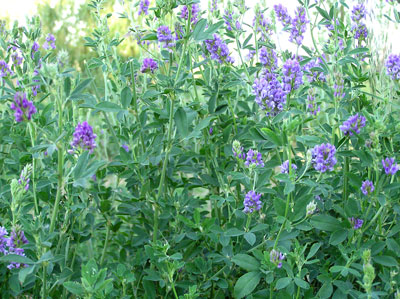
The queen of crops, lucerne is the most important silage ingredient in the world. It is used as silage, dried and as pastures. Lucerne is very high in crude protein, so it should be mixed with hay or grass to bring the CP down to a reasonable level. Lucerne also has lower fibre content and lower digestibility than hay, which are compensated by higher palatability. Compared to red clover, lucerne affects milk yield as well as or even better than red clover.

Straw
The gross energy of straw is high, but due to extremely low digestibility it yields practically no energy to the cow. Straw in a whole crop silage has more energy and higher digestibility than that of a fully ripened crops.  It is mostly used to increase the fibre content especially for dry cows and heifers. Straw is also very good for beed cattle fed with high amounts of concentrate, and for suckler cows. Straw is not necessary for cattle fed with hay- or grass-based silage.

whole crop silage
(c) takakita-net.co.jp
Whole crop silage
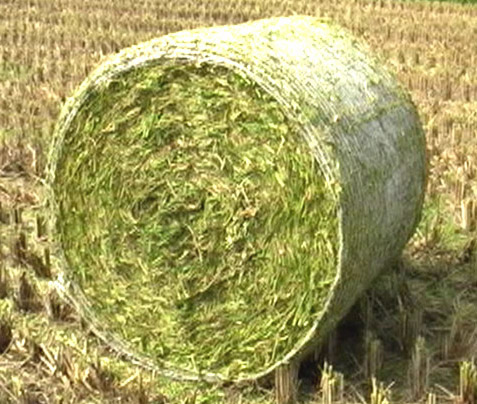
Wheat and barley are the most used species, because they have the highest palatability. Oat has a lower digestibility, and is used mostly for dry cows and heifers. Rye is palatable only if harvested early, but even then it is usually too expensive to be used for cattle feed. Whole crop silage can be used alone or together with grass- or hay-silage to offset the high crude protein content of the silage.

Harvesting of whole crop silage must be considered carefully. If it is harvested too early, the feed has low dry matter content and low digestibility, and may be difficult to preserve by fermentation. Late harvesting causes losses due to shedding, and the feed does not ferment. In addition to harvesting, the crops used and their properties impact the quality of whole crop silage.

Peas. (c) TerraLink
Pea
Peas have plenty of crude protein, and are best used in together with whole crop silage. Growing pea together with grains reduces the need for nitrogenous fertilizers and increases the protein content and digestibility of the silage. However, shedding losses may be noticeable, and peas are difficult to preserve by fermentation. Peas are annual plants and the seeds may be expensive, but if the harvesting is done well, the yield is high.

(c) Suomen Rehu
Commercial concentrates
Concentrate is used to increase the amount of one or more nutrient in the feed mix. Energy feeds and protein feeds are the most common ones used, but minerals and vitamins are also often part of concentrates. The impact of increased protein and energy on milk yield is limited, and can be minimal if the D-value of roughage is high. Too high amounts of concentrate reduce the amount og roughage eated, which again reduces the amount of fibre gained, and leads to bloat and acidosis. A commercial "full concentrate" has no grains, and contains usually 30-45 % CP and 10-11 ME MJ. A "semi-concentrate", which includes grains, has 23-30 % CP and 12-13 ME MJ.

More information

Dairy animal nutrition by Penn State University

Other posts in this blog about animal nutrition:
Feeding beef cattle
Feeding poulty
Legumes, rapeseed and grains in pig production
Determining feed digestibility
Value, quality and preservation of silage