Showing posts with label pigs. Show all posts

Thursday, 16 January 2014

Managing risk in animal breeding schemes

Animal breeding is not exact science in the sense that normally one cannot exactly predict the outcome, or even select the "ingredients". Each gamete (an egg cell or a sperm) is different, and their combination and further cellular divisions all include an effect of randomness. So each breeding scheme has risks. This post will address some of those risks and how to minimize their impact.

Inbreeding

Breeding always requires some inbreeding. This is because we want to increase the genes from one or few excellent animals, so we use them for males/females of several generations. Consider horse racing and show jumping: it's common to list the famous parents, siblings, half-sibs and grandparents of any horse to prove its value.

The change of inbreeding can be calculated as
ΔF= 1 / 2Ne
where Ne is the effective population size. If the pnumber of parents of different sexes isn't equal, then we estimate

ΔF ≈ (1 / 8Nm) + (1 / 8Nf)

Inbreeding works in two ways: inbreeding increases variance between lines/populations, but decreases variance among a line/population. Remember that inbreeding depression, the negative effect of inbreeding on genetic diversity, can be negated by breeding two animals of completely different lines.

Genomic selection versus progeny testing

Both agenomic selection schemes (GS) and progeny testing schemes (PT) have their own risks. Professors Alban Bucket  and Jarmo Juga from the University of Helsinki have studied the risks in bovines. They state that in GS schemes the rate of inbreeding is slightly higher than in PT schemes, but reciprocally the genetic response is much higher in GS than in PT. The choice becomes a matter of balancing the risks. How high of an inbreeding level do we accept to get strong genetic response? 

Bucket and Juga state that if the amount of sires is not increased, the risk is comparable between GS and PT schemes. The risk in GS can be further minimized by increasing the amount of MOET (multiple ovulation, embryo transfer) and the number of genotyped females.This increases the genetic diversity and allows effective Mendelian variance. However, increasing the amount of AI bulls in a GS scheme increases the risks of inbreeding.

Preserving genetic diversity

As has been stated earlier, selection and inbreeding impact genetic diversity in two ways: the variance between lines increases, while the variance within lines decreases. If a line equals a breed, the impact can be very strong.One example can be found from the study by Uimari and Tapio, who studied how the effective population size has changed over generations in two pig breeds. During 50 generations, selection has decreased the effective population size from 600 to a mere 50. The decrease is simply due to breeding selection.

The impact of selection to the Ne of two pig breeds.
(c) Uimari and Tapio

Maintaining genetic diversity should be duly considered in every breeding scheme. By genotyping a large amount of animals it is possible to ensure diversity by pairing unrelated animals. By genotyping one can also ensure that rare alleles stay in the population, and that there is enough heterozygozity. These two go often hand in hand: rare alleles are found most often in heterozygotes than in homozygotes. By genotyping one can also preserve traits of specific interest and genomically control the level of inbreeding.

FAO, The Food and Agriculture Organization, has created a simple chart about preserving genetic diversity. The chart is part of their publication considering The State of the Worlds ANGR for Food and Agriculture (ANGR = Animal genetic resources). It shows that the actions required are rather simple. Because really - 
all it takes is the courage to look beyond monetary gain and efficiency.


Wednesday, 27 February 2013

Piglet production

The aim of piglet producing is to have as many piglets per sow per year with as little costs as possible. Approximately sows give birth 2,3 times a year. One farrow has 10-17 piglets, of which a few often die at birth or soon after. Between birth and weaning, the mortality can rise up to 13 %. About 11 piglets are weaned from each farrow, and 21 piglets / sow / year.

The efficiency of piglet production is affected by four main factors:
  • Length of lactation period: Reducing the lactation time reduces fertility and number of piglets born. However, the sooned the piglets are weaned, the sooner the sow comes into heat and can be inseminated. 
  • Time from weaning to insemination: Sows come into heat twice after weaning. First heat is two days after weaning, but insemination at that time does not lead to fertilization. The other heat is 4-7 days after weaning. If the sow is not inseminated then, it takes three weeks before it comes into heat again.
  • Mortality of piglets: Reducing mortality directly increases piglet production. More piglets die in large farrows, so increasing farrow size is not the only solution.
  • Number of piglets in a farrow: To avoid  high mortality, large farrows must be evened out between lactating sows. Mortality rate can be over 40% in farrows of 18 piglets or more.  Each sow has fourteen teats, so they cannot nurse more piglets than that. Breed of the sow also affects its "efficiency". Mixed breed sows (local breed + yorkshire) have larger farrows and have their first farrow younger than purebreds. 
Pigs to be used as parents are selected at the weight of 80-90 kilos. They need more space than finishing pigs so they can develop strong muscles, and they should be fed more freely. Abundantly fed sows grow more, release more egg cells per ovulation, come into heat earlier and have their first farrow at a younger age, but their feeding costs are higher than limited-fed sows. Growing gilts need almost as much feed as growing pigs. Young boars are fed 10% less than growing pigs. Both gilts and young boards nees as much amino acids as growing pigs.

The ideal time to inseminate a sow for the first time is at 210-230 days of age. The sow's heat lasts 20-72 hours, usually 36-48 hours. Ovulation occurs 30-36 hours after the heat begins, but the eggs live only 8 hours after ovulation. Sows should be serviced (inseminated or mated) 10-30 hours after the heat starts, before the ovulation. Sperm cells need six hours in the uterus to adapt, before they can fertilize the eggs. If the sow is serviced during the optimum time, she will have a better chance of getting pregnant and a to have larger farrow.

Young sows release 10-20 eggs in one ovulation, and older sows 15-25 eggs. Free feeding before service increases the amount of eggs released. Eggs, which are fertilized, stay 12 days floating free in the uterus. Up to 30 % of the fertilized eggs will die during this phase.This phase is called preimplantation. The implantation phase is on days 13-40 from insemination. During implantation the eggs attach to the uterus,  the placenta develops and fetuses are formed. The fetus phase lasts until the end of the pregnancy. Sows are pregnant "3/3/3": three months, three weeks and three days. Approximately 115 days after the insemination the sow will give birth.

In intensive production unproductive sows are easily culled. Culling unproductive sows is done to ensure profitability, but also to avoid unhealthy piglets. Sows are often removed, if
  • they haven't come into heat at 8,5 months of age
  • less than 18 piglets are weaned from their two first farrows
  • the sum of days it takes for the sow to come into heat after two first farrowings is over 21 days
  • it isn't pregnant after service during two heats
  • it has farrowed twice or more, but produces less than 20 piglets a year
  • the sow is ill, doesn't nurse the piglets, has feet problems or loses much weight during lactation
  • there have been malformed or weak piglets in several farrows
  • their estimated breeding value decreases
  • they have farrowed more than six times, after which the litter size decreases

Nutrition of a pregnant and lactating sow

Gestating sows must get enough feed and especially protein for the fetuses to develop. If the sow gains too much weight during gestation, it will eat less after farrowing and lose a lot weight during lactation. Weightloss reduces fertility in the next heats. The condition score at insemination should be 3,5, and 3 right after weaning. Condition score is evaluated after second insemination (gilts) or after weaning (older sows).

Each sow should be fed individually during gestation. In practice they follow two phase diet. During gestation, they need 40-43 MJ ME/day, gilts needing more than older sows. Sows with a lot of moving space need slightly more feed. The feed must be fibrous, so the sows need to spend time eating and feel more satiated. It should have 5 g of intestinally digestable lysine per feed unit, or 12-14 % of crude protein. The feed can be "lactation feed" which has been diluted with grains. Young sows need more feed than old, because they still grow themselves.Thin sows (condition score 2 or 3) can be given 3 units a day. Five days before farrowing the amount of feed is cut drastically to less than 2 units a day. This will empty the intestines of the sow, making farrowing easier. Hay or straw should be given freely to avoid constipation.

(c) DonkeyHotey / Flickr
Lactating sows can be fed little during the first few days after farrowing, when their appetite is usually very low. Otherwise the feed will just spoil. After that sows are fed according to recommendations. Gilts need 80 MJ ME/day, but when the piglets grow, the amount is raised up to 93 ME MJ/day before weaning. Older sows (farrowed five times or more) need 85-98 ME MJ/day. Piglet feed can be mixed to the sow's lactation feed to ensure palatability and energy content. The feed should have 15-18 % of crude protein, and 42-51 grams of lysine a day. Protein need depends on farrow size and lactation phase. Sows also need enough calcium (8 g / feed unit), 6 g of P and 4 g of salt. Vitamins, magnesium, iron, zinc, copper, iodine and selenium are also important, and easily gained from a premix or concentrate. Feed for lactating sows must be palatable, and can be given several times a day to ensure adequate eating.

Inadequate feeding during lactation increases the dry matter content of the milk, but decreases total milk yield and protein content. Underfed sows also lose more body fat and muscle. Their piglets grow less, and have less protein and more fat than piglets from an  ideally fed sow. It is more effective for a sow to get energy using its own tissues than from feed, so some weight loss is likely even for an ideally fed sow.

See details from Formulating farm-specific swine diets (University of Minnesota).


Caring for piglets

Piglets are born without any immunity or ability to thermoregulate ( = to regulate their body temperature). The temperature inside the sow's womb is nearly 40 C, but only 20 C in the piggery, so piglets are cold and need a heat source to stay warm. The pen has to be clean, desinfected and have enough straw or other dry litter. New-born piglets weigh about 1,5 kilograms. 50-70 % of new-born piglets weighing less 800 g die soon after birth.

First born piglets get to the sow's teats sooner than others, and usually grow faster. They need colostrum during the first hours to build immunity, and to get energy for maintaining body heat. Colostrum is also rich in fat, lactose, vitamins, minerals and proteins. Piglets cannot mobilize their own tissues to get energy. Lack of milk causes the blood glucose level to drop, which makes the piglets drowsy and weak, and unable to seek nutrition. As their body heat and glucose levels continue to decrease, the piglets will fall into come and die.  Weak and last-born piglets can be guided to the teats.

(c) Organicpork.co.uk
Piglets suckle 20-23 times a day, about 5 minutes at a time. Most of time is spent butting the udder so the milk is released from the alveols. Suckling piglets get milk only for half a minute, about 0,6 dl each. The milk yield increases at each parturition from 8 to 10 kg / day. Number of piglets increases the milk yield as well, but only little, so each piglet gets less milk if the farrow is large. The sow calls the piglets for suckle with low grunts. If the piggery is noisy, the piglets cannot hear the sow, and will die soon of malnutrition. Noisy piggery also prevents the sow to hear its piglets screaming if she accidentally is laying down or sitting on them, making it impossible for her to watch out for her young.

After the first week solid food should be offered to the piglets. For some piglets this becomes an important source of nutrition. Their intestinal epithelium, enzymatic activity and stomach acid formation develop faster if they get solid food in addition to milk. At weaning these piglets are better prepared to eat only solid feed. Their chance to get diarrhea and lose weight is decreased. They also may be calmer if they've used the feed as a stimulus. Best ingredients for piglet feed are wheat and peeled oats. Small amounts of oats, barley, and whey can also be used.

At three weeks of age the piglet starts to develop its own immune system, and is no longer dependent on milk. This is also the time they are weaned, and the stress combined with low level of immunity often causes diarrhea and even deaths. If the piglets are weak or small, it is recommended to postpone weaning until the piglets are four or five weeks old.

(c) newlandpoultry.com


Sunday, 24 February 2013

Legumes, rapeseed and grains in pig nutrition

This text considers the usage of legumes and rapeseed as protein source in pig nutrition. Various species of legumes are discussed, and their digestibility and nutrition contents are compared. Finally minerals are discussed, why are they needed and how to make sure inbdoors-raised pigs get all the needed minerals from their feed.

Legumes

Legumes are shrubs, herbs and trees that grow multi-leaf stalks and reproductive flowers that produce pod-shaped fruit. The pods typically house the pulses, which are are the seeds of a legume. Legumes are part of the pea, bean and lentil families. From legumes, only seeds are used in pig nutrition. Pulses can be used to replace soybean meal, which is the most common protein source in pig nutrition. Pulses are grinded to fit either solid or liquid feed. The most common pulses used in Europe are pea, broad bean, lupine, rape, and chickling. By-products of alcohol and bakery industries are also used as protein source.

Growing legumes diversify crop rotation, bind nitrogen and improve soil. Using pulses in pig feed usually needs no additional equipment or machinery, and can be used to increase self-sufficiency in protein feeds. However, they are sensitive to weather, and only the seeds are usable for pig feed. Most of the biomass thus goes to waste. It may also be difficult to find commercial complementary feeds for home-made pulse feed.

Nutritional content and toxic agents
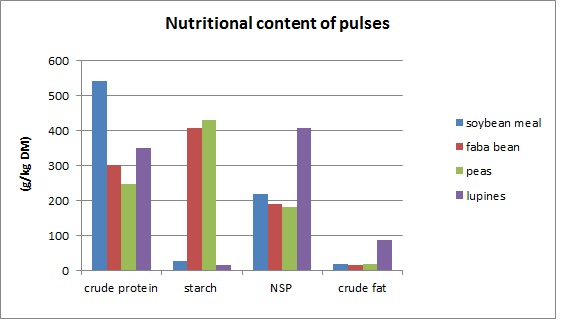
Grain legume (pea, broad bean and lupines) pulses contain mainly water-soluble protein, which has a digestibility of 85 %. They have a lot of lysine, but may lack sulphurous amino acids methionine and cystine.The higher the crude protein content in a pulse, the lower the amount of sulphurous amino acids. Compared to soy bean meal, all pulses have about 50 % less lysine and 60% less methionine and tryptophan. Intestinal digestibility of lupines equals that of soybean meal, but other pulses fall slightly behind.


Soybean meal has much as much starch as lupines. Lupines are higher in cellulose content, and may cause mild diarrhea due to their high fibre content. Faba beans and peas have seven times more starch but less sucrose than soybean.

Lupines have a much higher fat content than other pulses, soybeans included. All pulses have much polyunsaturated fatty acids, which soften the lard (pig fat) if fed in high amounts. While soft lard is healthier for humans, it makes handling and processing the carcass more difficult.

Pulses have several toxic agents. Lectines are protease inhibitors, inhibiting protein-degrading enzymes from working and lowering the digestibility.They bind into the epitelial cells of the small intestine, damaging the mucuous membrane and affecting the immune system. Peas and faba beans have much less lectines than soybean meal. Other protease-inhibitors affect the pancreatic enzymes trypsine and chymotrypsine, which split amino acids from proteins. Soybeans are high in protease-inhibitors. Heat-processing the pulses destroys the inhibitors. Tannines may bind proteins to themselves, which inreases endogenous excretion and decreases protein digestibility. Tannines also negatively affect the taste of the feed. White-flowered legumes have no tannines. Pulses from legumes with colored flowers should be peeled, since tannines are located in the husk of the seed. Alkaloids are toxic amines found only in lupines. They disrupt the central nervous system, decrease digestibility of all nutrients, decrease fertility and cause the feed to taste bitter. No feed should have more than 0,2-0,3 grams of alkaloids per kilogram of dry matter. ODAP can be found only in chickling fetch/grass pea (Lathyrys sativus). It is a neurotoxine, which in high amounts causes permanent paralysis. ODAP content can be lowered by soaking, fermenting and heat-processing the seeds. Overall, contaminants are not a concern when using white-flowered legumes.

Less serious contaminants are vicine, saponines and alfa-galactosides. Vicine and covicine are typical for faba beans, and may affect fertility in sows. Saponines are found in legumes with colored flowes, and they taste bitter but cause no severe problems. Alfa-galactosides are carbohydrates, which pigs cannot digest at all. They are used by microbes in the colon, increasing gas production.

Using pulses in pig nutrition
Due to variable nutritional content and many contaminants, the use of pulses in pig feed must be limited. The food for sows should have a maximum of 10 % of any pulse. Piglets under 25 kg can be fed 5-15 % of pulses. Finishing pigs over 50 kg can have up to 40 % of pea, 20 % faba bean and 15 % of blue lupine in their daily feed.

Rapeseed

There are two subspecies of rapeseed: Turnip rape (Brassica rapa) and rape (Brassica napus).  They are usually not separated in processing, and thus rape products may include turnip rape as well. Here both are referred to as rapeseed. Rapeseed is used in pig nutrition as compressed cakes, powdered seeds or groats. Organic production relies heavily on rapeseed for protein, and they also include a lot of necessary phosphorus and healthy fatty acids. Organic producers cannot however use rapeseed meals which are produced using ether extraction. Rapeseeds are high in fibre content, so they fit especially well for sows.

Rapeseeds contain two toxic agents: glucosinolates and erucic acid. Only the so-called 00-variants of rape are free from both compounds. Glucosinolates are sulphurous, aliphatic compounds found in cruciferous plants. Glucosinolates cause bitter taste, decrease the metabolism of iodine in the thryroid gland and may damage the liver if their amount in feed exceeds 7 μmol/g. Crops cultivated in cool and humid environment develop less toxic agents than crops in hot and dry environments. When rapeseeds are processed, most of the glucosinolates stay in the pressed cakes.They can also be partially destroyed by heat-processing. The effects of erucic acid  are controversial and not very well known.

Soybean meals can be entirely replaced with rapeseed groats or heat-processed, pressed rapeseed cakes for growing meat pigs. Only a third of soy can be replaced with rapeseed for sows. Rapeseed-fed sows lose less weight after parturition and their piglets weigh more when born and when weaned.

Minerals

From minerals, calcium and phosphorus are the most important for pigs since they are needed for muscle contractions, nervous system, energy metabolism and blood clotting. Strong bones require the right ratio of Ca and P. Phosphorus is absorbed from the small intestine with the help of Na-transferrers, which again need vitamin D to work. Absorption of Calcium aso needs vitamin D. If the animal gets more phosphorus than it needs or the phosphorus is in an insoluble form, the excess will be secreted in urine.

Sheep with inherited rickets. (c) Dittmer, Thompson, Blair 2009
Lack of Ca, P and vitamin D causes rickets in young animals and osteomalacia in old. Pigs need to get 1,2-1,4 times more Ca than P. Exceeding the needed amount of Ca decreases the absorbancy of zinc and can cause skin problems for young pigs. Pregnant sows with calcium deficiency have weak contractions, and piglets are born with oxygen-deficieny and covered in feces. The probability of uterus infection is also increased.

50-90 % of the phosphorus in plants exists as phytic acid (inositol hexakisphosphate). Compressed rapeseed and rapeseed groats contain most free phosphorus, approximately 11 g P / kg dry matter (DM), but as much as 32 grams of phytic acid in a kilogram of DM. Barley, wheat and oats contain only 3,5 g P / kg DM and 10 g phytic acid / kg DM. Phytic acid exists as K- and Mg-salts, and forms complexes with other positively charged ions. Monogastric animals like swine cannot digest phytic acid. They need an enzyme called phytase to remove phosphate from the inositol ring in the phytate molecule. Often phytase is added to pig feed, because the natural phytase in plants is destroyed in heat-processing. Some by-products of alcohol industry (barley protein feed) have almost only free P, since the phytic acid denaturates in the ethanol creation process.

Grains

Grains, and especially barley, is the most important component in pig nutrition in Europe. Barley can be given to pigs of all ages, and without mixing it to other ingredients. Oats are very fibrous, and are used mostly for sows to replace 50% of the barley. For meat pigs, the diet must contain less than 50% of wheat and oats to avoid softening the lard. Rye is not commonly used at all, but may be used in small proportions for growing pigs.

All grains must be fed either dried or as silage, but the grains must be flattened, grinded or powdered before feeding. Grinded grains preserved with propionic acid are safe to feed, since the acid is a natural product of the gastric system, and it keeps the grain free from spores, fungi and mold. Anaerobic preservation can also be used. Grains must always be clean and in good condition before feeding. Moldy grains cause gastric problems or other severe effects, and sprouted and very light grains have only low nutritional value. Moldy grains cannot be given to sows and piglets at all.

All grains contain roughly the same amount of starch, ash and crude protein. Whole-grain oats and barley have the most crude carbohydrates (hemicellulose, cellulose and lignin), but peeled oats and barley have less CC than whole-grain wheat and rye. Compared to soybean meals, grains contains approximately 2/3 less protein. The amino acids in grains have intestinal digestibility of 60-90 depending on the amino acid. Grains fertilized with nitrogen contain 2 % more protein, but less lysine than non-nitrogen-fertilized grains.

Grains must be harvested at the right time and silaged and grinded properly. Good grains are clean, bright-colored and smell fresh. A hectolitre of barley should weight over 66 kgs and oat over 56 kgs. Lighter grains have less organic matter and considerably more neutral detergent fibres, which make the grains less digestible. All grains must be dried to 14 % of moisture immediately after harvesting to ensure microbiological quality. The protein content must be analyzed and found to be around 12-13 %. Barley must contain over 59 % of starch (in dry matter). Grains should be stored so that birds, pigs or pests cannot contaminate them with feces.


More information

Plants poisonous to livestock (Cornell University): http://www.ansci.cornell.edu/plants/php/plants.php?action=display&ispecies=swine

Jezierny, D.; Mosenthin, R.; Bauer, E. 2010. The use of grain legumes as a protein source in pig nutrition: A review.  Animal Feed Science and Technology vol. 157 issue 3-4 May 11, 2010. p. 111-128

Partanen K., Valaja J., Jalava T., Siljander-Rasi H. 2001. Composition, ileal amino acid digestibility and nutritive value of organically grown legume seeds and conventional rapeseed cakes for pigs. Agricultural and food science in Finland, Vol 10 (2001): 309-322.

Friday, 22 February 2013

Pig nutrition: minerals and vitamins

Minerals are inorganic elements, which are divided into trace elements (or microminerals) and macrominerals depending on how much of each is present in the animal body. Trace elements are those elements, which the animal needs less than 0,01 % of the dry matter weight of it's tissues. Minerals are needed for three tasks ( (T) after the element name denotes it's a trace element):
  • Building tissues
    • Calcium
    • Phosphorus
    • Magnesium
    • Silicon (T)
    •  Fluorine (T)
    • Sulphur
  • Regulating osmotic pressure and permeability of cell membranes
    • Sodium
    • Potassium
    • Chlorine
    • Calcium
    • Magnesium
  • Catalyzing enzymatic and hormonal regulation
    • Iron (T)
    • Cobalt (T)
    • Zinc (T)
    • Manganese (T)
    • Molybden (T)
    • Selenium (T)
Vitamins are biologically active, organic compounds, which are necessary for normal bodily functions, and cannot be replaced with any other compound. Many vitamins are a part of an enzyme. Vitamins have five basic functions: antioxidant activity, proton/electron recipient, hormonal activity, coenzymatic activity and participation in genetic transcription.

Pigs need to get most of their vitamins from the feed. The vitamin content of feeds decrease during storage and processing,  so especially highly productive animals need vitamin additions. Age, health, stress, diet composition, gender and physiological state affect the need for vitamins. Vitamins of the K- and B-groups are formed in the color by microbes, but absorbancy may be weak. The minimum dose is where no symptoms of deficiency are apparent. The optimum need is the amount of vitamins needed to secure as high a production as possible, health, resistance against illnesses and adequate vitamin reserves.Exceeding the optimum need is costly, since the excess is secreted out from the body. Vitamins may also have toxic effects if the dosage is greatly exceeded for a long period of time.

Pigs are often raised indoors, so they cannot synthetize D vitamin from sunlight at all. Normally pigs could get K and B vitamins from feces, but if there's grating on the floor, this too becomes impossible. The most often needed vitamins are already added to commercial pig feeds and concetrates: A, D and E vitamins, niacin (B3), pantothenic acid (B5), riboflavin (B2) and B12.  Basic vitamin need stays the same for the entire life of a meat pig, but sows and and boars need more vitamin A and D than growing pigs and piglets. Sows and boars also need added choline, folic acid and K-vitamin.

The details of the different vitamins are discussed in another post about vitamins. Some vitamins have specific effects on  pigs:
  • Vitamin E: increases litter size, prevents milk fever, increases immunity on sows and piglets
  • Choline: increases fertility of sows and the amount of piglets born alive. Pigs can synthetize choline from methionine.
  • Vitamin K: additions are needed for pregnant sows, so the vitamin can permeate the placenta and also absorb into the colostrum
  • Biotine: may improve claw health

Friday, 15 February 2013

Energy and protein metabolism in pigs

Metabolism is defines as the chemical changes in living cells by which energy is provided for vital processes and activities and new material is assimilate, as the sum of the processes by which a particular substance is handled in the living body and as the sum of the metabolic activities taking place in a particular environment. This text describes the metabolism of energy and proteins in pigs.

Energy metabolism

A pig needs energy for maintenance (necessary bodily functions) and for production (growth, lactation, piglet production). Pigs get energy from all organic compunds which they can digest, absorb and which their metabolic routes can use.  Energy is gained from carbohydrates, proteins, fats and organic acids. Carbohydrates are the most important energy source, but pigs can digest only starch and sugars, no cellulose or lignin.


Levels of energy (c) Evonik.com
Only a part of the energy gained is used for maintenance or production. Loss of energy happens in three stages:
  • Gross energy: all the energy gained from feed
  • Digestible energy: gross energy - energy in feces
  • Metabolizable energy: digestible energy -
    - the energy in urine and metabolic gases
  • Net energy: metabolizable energy - energy of heat produced by basic metabolism (heat increment)

Of these levels, net energy (NE) is the actual amount of energy the animal can use for production. It is only approximately 60 % of the gross energy (GE). Most energy is lost in heat (~20 %) and feces (~18 %). Chemically, oxidizing one mole of glucose (2870 kJ) produces 1976 kJ, so only 69 % is used as energy and 30 % lost as heat.

Energy is used primarily for maintenance. If a pig gets less energy than it needs for the maintenance, it utilizes its tissues and loses weight. When the energy gain exceeds the maintenance level (over 10 ME / day) , a pig is able to retain proteins and water into its tissues, building muscles. If plenty of energy is still available, pigs will convert the extra energy as body fat, which is not desirable in meat production. A pig growing 850g a day uses 3,8 MJ to gain 160g of protein for its muscles, 4,1 MJ to gain 105 of fat and 6,7 MJ for metabolism.

Nutrients can be either used as energy or in building body tissues. If fatty acids are used for energy, 66 % of the energy can be utilized. When using fatty acids for creating adipose tissue, the transformation efficiency is 90 %. For glucose the percentages are 68 % (for energy) and 74 % (for fat). From carbohydrates, starch, saccharose and glucose are most effective with 67 % of energy utilized as ATP. 

The amount and type of fibres in the feed affect the digestibility of carbohydrates. Pig feed must have enough sugar and starch to provide the needed energy.The more dietary fibre the feed has, the less energy is metabolizable. If the feed has 50 % of fibre, ~55 % of energy is metabolized. Neutral-detergent fibre (NDF) cannot be used by pigs, so the more NDF a feed has, the less energy pigs can get. High amounts of fibre also increase microbial fermentation in the colon, which increases loss of energy in gases.


Energy contents of nutrients and different feeds.


Protein metabolism 

Pigs need protein for several functions: own muscle growth, milk production and muscle growth for piglets, creation of enzymes and other proteins in the body, etc.

Animals don't actually need proteins but amino acids, which are the building blocks of proteins. Most important amino acids for pigs are lycine and metionine, but there are 9 essential amino acids in all. These amino acids can be mixed directly to the feed either as pure amino acids or as a part of a premix. The composition of amino acids in a feed determines its value as a protein source. When using home-made feeds, the amino acid composition must be determined with tests. It is also important to determine the intestinal digestibility of the amino acids. The need for amino acids can be scientifically determined by measuring production parameters (growth, carcass composition) and metabolic parameters (nitrogen in urine, urine and amino acids in plasma). The optimal composition of amino acids is called the "ideal protein", where every amino acid is present at the same time and at the correct ratio.

Animals can build non-essential amino acids only if they get enough of the essential ones at the same time. Essential amino acids cannot be synthetized at all. Unused or spare amino acids are fermented into ammonia by microbes in the colon, and the ammonia is then transferred into the liver and secreted as nitrogen. Pigs can only use amino acids which are absorbed from the small intestine. Excretion is an energy-consuming process, and increases the nitrogen emissions from pig production.

Comparing common feeds to the ideal protein gives an estimate on which amino acids and how much should be added to the feed. Barley meal lacks lysine and threonine the most,while soybean meal has almost enough of every amino acid, some even in excess. Maize lacks especially lysine and tryptophan, peas methionine and cysteine and fish meal histidine, phenylalanine and tyrosine. Digestibility trials show that adding lysine increases meat production in sows and hogs alike.

Proteins, which pigs get from their feed, are first denaturated to peptides in the stomach by HCl and pepsin. The peptides continue into the intestine, where several pancreatic enzymes break them further into oligopeptides. The intestinal wall secretes dipeptidase and aminopeptidase, which split the oligopeptides into amino acids. Amino acids are absorbed through the intestinal wall against the concentration gradient. Small peptides are also absorbed and hydrolysed. Blood stream carries the peptides and amino acids into different tissues, where they are used for protein synthesis and as energy. 

Different feeds induce a different amount of endogenous secretion: the secretion of mucus, microbe material and other nitrogenous compounds in the feces. Endogenous excretion must be taken into account when doing digestibility and metabolization trials. True digestibility excludes endogenous excretion, while apparent digestibility includes it. The digestibility of amino acids also varies between meals. Lysine is digested best from soybean meal and maize, and least from beet pulp and wheat. 

Soybean, fish and corn meals. (c)http://fomicanimalmeal.en.ec21.com
The need for protein can be calculated using a simple formula:
I = a (M + R/e)
where
I = need of amino acids from feed
a = utilization efficiency of amino acids
M = protein need for maintenance
R = protein need for muscle growth
e = degree of utilization


Wednesday, 14 November 2012

Behaviour and welfare of pigs

Pigs differ from other ungulates in many aspects: they give birth to many offspring at once, they are omnivorous, they build a nest, sleep for 12-14 hours straight and they prefer to rest close to other members of the pack. Pigs were originally domesticated from wild boars 9000 years ago in Turkey. Like chickens, pigs have changed in phenotype, but they still share instincts with their wild ancestors. Pigs are omnivorous: they eat vegetables, mushrooms, nuts, fruit, insects, worms, small animals and even carcasses.

Senses and social behaviour

Pigs rely strongly on their sense of smell and hearing. Sows recognize their piglets by smell, and boars smell the sows to check their heat. Voice and hearing are very important in the social behaviour of pigs. Pigs "chat" nearly constantly in quiet grunts to stay in contact with their pack. Warning signals and cries for help are high-pitched and loud. Boars sing a "love song" to attract sows, and the sow's voice signals tell the piglets when milk is available.

(c) Daily Mail. Check their article about pig slaughtering.
Pigs can't see very well. Thus their gestures are not subtle and small, but require a lot of space. For example, a dog recognizes a slight turn of the head as a calming signal. If a pig needs to calm a stronger animal, it turns away completely and then runs away for a short distance. In piggeries this is often impossible, so fights and injuries are common. Naturally pigs live in peaceful groups with stable social structure. In piggeries groups are often mixed, so the structure changes a lot and the animals have to create the "pecking order" over and over again.

Unlike many other animals, pigs are contact animals. A sow does not lick its piglets, nor do pigs lick one another. Instead, they eat in groups and sleep side by side, close together. Even mating behaviour is rather straightforward: instead of courting, the boar can just mount the sow. Sows have a standing reflex, which means that in heat it will stand still when pressure is applied to it's loins. In addition to sleeping, eating is also synchronized. Pigs wake up at sunrise, and spend most of their time nosing the ground for food. They eat for 8 hours, and sleep 12-14 hours a day.

(c) visualphotos.com
Cleanliness: Contrary to popular belief, pigs are very tidy animals. They always separate a sleeping area from eating area and "bathroom" area. In piggeries this is not possible, and pigs are forced to sleep in their feces and eat in a dirty environment.

Skin care: Pigs have two ways for skin care: wallowing in mud and scratching themselves against walls. Wallowing in mud is not just fun, it also cools the animal on a hot day, rubs away dead skin and removes parasites.

Thermoregulation: Piglets under 3 weeks of age cannot thermoregulate, and in piggeries they depend on heat lamps. In the wild piglets live in a nest built by the sow, so they stay warm. Adult pigs have almost no fur and no sweat glands, so they can thermoregulate only by changing their behaviour.

Parturition and weaning

One or two days before giving birth, sows start to look for a place for a nest. They may wander several kilometers searching for a good spot. 6-12 hours before parturition the sow begins the actual nest building. It digs a shallow hole, and then collects branches, hay, turf and other materials, which it uses to build a nest. 1-2 hours before parturition the sow lays down on her nest. When the piglets are born, the sow lays passively. Domesticated pigs give birth to 10-15 piglets, which are born about 15 minutes from one another. After birth piglets instinctively crawl to the udder and start suckling. If a piglet doesn't get colostrum within few hours of birth, it will die. Colostrum is vital, for the piglets have no antibodies. If the sow is vaccinated before parturition, the piglets will get immunity as well.

For the first three days the piglets fight for teats, but they then develop a clear "teat order": each piglet has its own teat. This is important, because after 12 hours the sow gives milk only once every 45 minutes. It announces milk letting by grunting, and every piglet has about 10 minutes to find a teat and suckle.

(c) Keith Weller / Shutterstock
The sow stays in her nest for the first 1-2 days, after which she leaves the nest for a short time as she goes eating. On 4th - 5th day the piglets leave their nest to follow the sow, and learn to find solid food. After 10-14 days the sow and her litter leave the nest and return to the herd. If the piglets do not follow the sow at this time, she may abandon the whole litter. The sow starts weaning her litter from the first week by slowly introducing the piglets to solid food and by regulating her milk letting. Final weaning will happen when the piglets are 10-25 weeks old, depending on the availability of food.

In piggeries sows are not allowed to build nests, and they are often confined to tiny parturition crates for weeks. The crates don't allow the sow to turn around, sometimes not even to stand up. Crates are used so the sow wouldn't lie down on the piglets. Naturally the sow has an anti-crushing behaviour, but in piggeries the sow often cannot hear if a piglet screams when sat on. Studies show that parturition is faster, more piglets are born alive and the sow lets more milk when giving birth freely, compared to birthing crate. Building a having a sest also calms the sow, calms the parturition and improves the relationship beween the sow and the piglets.

Welfare of pigs

The welfare of pigs consists of several basic building blocks:
  • health
  • air quality and temperature
  • Pen structure (size of pen, flooring material)
  • availability of litter and  other stimuli
  • social environment (stable groups)
  • feeding (appropriate feed, enough space for all pigs to eat at the same time, enough roughage)
  • Attitude and skills of the caretaker
Pigs would eat for 8 hours every day. In a piggery this isn't possible, so the animals need plenty of modifiable litter and other objects which they can nose, chew, eat or otherwise modify. Straw, tree branches or hemp / sisal ropes are very good for this purpose. Problems with any of the factors of pig welfare may lead to the most serious behavioral prolem in any piggery: tail biting. Tail biting has been discussed in the entry about pig diseases.

In piggeries, pigs are moved from one department or piggery to one another several times. Each department should take into consideration the needs pigs have at that particular age.

Parturition dept: Since piglets are very sensitive, clean, dry and warm environment is vital for them. During the first few days piglets are castrated, ear-marked, given a tattoo and an iron injection, and their canines are filed. All these cause pain and risk for infections. Parturition dept must have clean space available for these operations. Flooring material is important, so the feces and urine can be cleaned, but the floor isn't too hard or cold for the piglets.

Intensive piggery, a "hog lot"(c) Wikipedia
Weaning dept: High-quality and clean water and feed are important to young pigs, who still have no stomach acids to kill any bacteria they ingest. Stable groups and temperature are needed, and stimuli help the pigs to relieve stress and pass the time.

Meat pig farm: For adult pigs, stable groups and enough space are important. They must be able to sleep together and eat together, have separate areas for eating, sleeping and defecating/urinating, and they need space for social behaviour. Stimuli are also important. Temperature can vary more than in previous departments.

Department for pregnant sows: Like the meat pig farm, but pregnant sows need even more space than meat pigs.