Showing posts with label fat. Show all posts

Sunday, 16 February 2014

Beef production: Breeds and beef quality

Beef cattle are generally sturdier, meatier and larger than dairy breeds. In addition, they may have stronger maternal instincts, because in several systems the dam suckles her calves for several months. In dairy farming, calves are usually taken from the dam within 24 hours from birth. The information here is referenced from the website of Oklahoma State University and from other sources.

Angus or Aberdeen Angus is a medium-sized beef breed with either black or red coloring. Grows slower and gains fat faster than larger breeds.
Size (cows): 650-850 kg
Size (bulls): 1000-1300 kg


Belgian Blue has a mutation, which causes it to be double-muscled. The extreme size of its muscles causes severe problems when calving, and most cows must undergo several cesarean sections during their lives.
Size (cows): 700-850 kg (source)
Size (bulls): 1100-1250 kg

Blonde d'Aquitane, or blond, is a muscular and docile breed.
Size (cows): 700-900 kg
Size (bulls): 1200-1400 kg


Charolais is a white or cream-colored, large beef breed from France. It grows fast and generally gains fat slower than smaller breeds.
Size (cows): 700-950 kg
Size (bulls): 1200-1400 kg
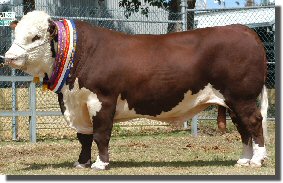


(c) http://yallaroo.murrayfrancis.com/

Herefords are massive, red and white colored animals. The head is usually entirely white and covered in curly, thick fur. Grows slower and gains fat faster than larger breeds.
Size (cows): 600-850 kg
Size (bulls): 1100-1300 kg


 Simmental is colored much like the Hereford, but the head is usually not entirely white. It is originally from the Simme Valley in Switzerland. It grows fast and generally gains fat slower than smaller breeds.
Size (cows): 700-950 kg
Size (bulls): 1200-1400 kg


Limousin  is another French beef cattle breed, and has originally been used as a working animal as well as for beef production. It has a high carcass percentage, i.e. the ratio between carcass weight and live weight. It grows fast and generally gains fat slower than smaller breeds.
Size (cows): 650-850 kg
Size (bulls): 1100-1300 kg


Carcass quality

Beef quality starts from carcass quality. A carcass is more valuable the less fat and bone is has, as the meat is the only economically important portion. The measurements are subjective, and based on the shape of the carcass. Most valuable cuts are evaluated especially carefully. In the European Union carcass quality is measured in an europ-scale: S > E > U > R > O > P (EEC  1208/81):

  • S (superior) = All profiles extremely convex; exceptional muscle development (double-muscled carcase type)
  • E (excellent) = All profiles convex to super-convex; exceptional muscle development
  • U (Very good) = Profiles on the whole convex; very good muscle development
  • R (Good) = Profiles on the whole straight; good muscle develop- ment
  • O (Fair) = Profiles straight to concave; average muscle develop- ment
  • P (Poor) = All profiles concave to very concave; poor muscle development
In addition to the EUROP-scale, the fatness of the carcass is evaluated from scale 1 (fat-free) to 5 (extremely fatty).

Two important concepts to consider are live weight and carcass weight. Live weight is the weight of the entire animal. Carcasss weight is live weight minus the weight of the head, genitalia, udder, digestive tract, internal organs, hide and hooves. The ratio between carcass weight and live weight is called carcass percentage. Carcass percentage varies between breeds, but is commonly 50-60 %.

When the carcass weight increases, to which the farmers often aim at, the relative proportion of lean meat decreases. In proportion, the amount of fat increases. The portion of the most valuable cuts (steak and filet) from the entire carcass does not change. Carcass weight can be increased by using plenty of concentrated feed, but a more effective method is to limit fattening by limiting energy intake at the finishing phase of the rearing.

Beef quality

Muscle becomes meat or beef after the animal has been slaughtered. Slaughtering causes chemical, physiological and biological changes in the muscle tissue. To prevent harmful changes, the animal and the meat must be handled correctly.

Beef quality consists of several factors:
  • Physiochemical properties: pH, color, sarcomere length, run-off, consistency
  • Chemical properties: Dry matter content, amount of protein, amount of fat
  • Sensory properties: juiciness, flavor, tenderness
Meat becomes stringy and chewy when the myocine and actin filaments of the muscle stick together after death (rigor mortis). Usually carcases are cooled under +7 C before rigor mortis sets in, which causes the muscle to constrict due to cold. To prevent cold constriction the meat may be stimulated with electricity. Once the meat is cooked, the proteins break and the meat becomes tender.

Juiciness means the amount of muscle fluid which is released when the cooked meat is bitten into. It
is related to the amount of fat in the meat, since fat increases the water retention capacity. The largest part, 64-80 %, of beef is water. The water is retained between actin and myocin filaments. Water retention capacity decreases as the pH decreases after slaughtering. The pH of muscle is 7,2, but it drops to 5,6 within 24 hours after death. Fat percentage varies between 2-25 %. 

If the animal has little glycogen in its body right prior to slaughter, the meat does not develop enough lactic acid after slaughtering and the pH does not drop as fast and low as it should. This results in a tar meat, or DFD meat (dark, firm, dry). DFD meat is not used for whole-meat products because it has poor shelf life. 


Friday, 14 February 2014

Beef production: Basics

 Beef production is the production of beef and veal, i.e. the meat from cows, steers, bulls, heifers and calves. First we look at the differences between beef production to the production of other types of meat. Then we discuss the anatomy of meat, the growth of the beef animals and their carcass composition. The different methods of rearing beef cattle are discussed in later posts.

What is beef? Beef is the meat from bovines, that is "cows" of different age, gender and breed. The beef you see in a market comes either from beef production, milk production or from a combined farm with both milk and beef production. In Northern Europe, for instance, nearly 90 % of all beed originates from the dairy industry.

Compared with other animals reared for their meat, cows are relatively inefficient at transforming vegetation into meat protein. Dairy cows produce much protein and energy to their milk, but as meat producers they are even less efficient than beef cows.The chart on the left shows only the energy and protein in edible cuts. Energy in tallow, lard etc is not included.

One can also compare the animal species in terms of how well they utilize nitrogen. Feed N recovery efficiency in the edible weight fraction is defined as the percentage of the N in the animal feed that ends up in the edible portion of the animal. N recovery efficiency is low in beef production, only 8 %, but much higher for pork (~20%) and poultry (~30%). (Oenema et al. 2005)

Growth models and carcass composition

Growth can mean either the actual daily growth of an animal, the extra growth it puts on due to management and feeding, or the increase in edible cuts. For example: A calf grows 1500 grams a day (actual growth). Of  that, 400 grams is due to heavy feeding (extra growth). After the calf is slaughtered one can then calculate backwards how much of the 1500g went to the edible meat (increase in edible cuts).

Growth consists of four types of changes:
  1. Changes in size (live weight)
  2. Changes in appearance (height, diameter of chest...)
  3. Changes in anatomical composition (fat percentage, ...)
  4. Changes in chemical composition (chemical composition of muscles, fat etc)
Change in size, for example the weight, is an inaccurate measurement because it is affected by what the animal has eaten and drank. The weight of the digestive tract of a bovine varies tens of kilos during the day. The weight of a cow inceases most rapidly from birth until 6 months of age, when the growth slows and finally comes to an end at the age of 2-3 years. The model is very simplified, because bones, muscles, connective tissue and nerves have a very different rate of growth. This also affects the third measurement: the anatomical composition. First the animal gains mostly bones and nerves, then muscles and finally fat, all altering the anatomical composition of the carcass.

Daily growth is measured either as the proportion of daily growth to the live weight, i.e. 1500g / 250kg = 0,006 %, or simply as g/day. Final weight of beef breeds varies from 350 kg (a Dexter cow) to 1400 kg (Charolais bull). Bulls grow 10-20 % faster than steers (castrated bulls), while steers grow as fast as heifers (Galbraith and Topps 1982).

Changes in appeareance only describe how the different parts of the animal grow in proportion to one another. For example a calf has tall feet and a shallow chest, while a grown cow has shorter feet and very wide chest.

Chemical changes describe the changes in the composition of the body. The higher the live weight, the more fat there is in a kilo of carcass, and therefore also the relative energy content increases. At the same time the relative portion of crude protein decreases. As with all young animals, first to grow are the bones and nerve tissue, with muscles next and finally body fat. Breed and gender also affect the carcass composition. Steers gain 10-45 % more fat than bulls, and breeds like Angus and Hereford are fatter than for example Limousin and Charolais. Note that breed does NOT affect the composition of the lean (fatless) carcass.

All in all, the growth of an animal is summarized in the picture below (Rumsey 1991).


The anatomy of muscles

30-40 % of the live weight of a bovine consist of skeletal muscles. The quality of edible meat is affected by the chemical, biochemical and physiological qualities of the muscle both before and after slaughter. Growth, feeding, animal handling and meat processing after slaughter also all have an impact on the quality of the meat.For bovines, 30 largest muscles contribute 75 % of the weight of all the muscles. The largest muscle groups are in the pelvic limb (hind quarters) with 28,5 % of live weight, and neck/thorax with 22,4 %.

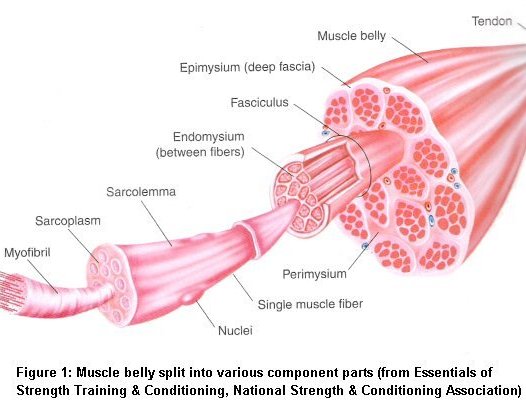
The anatomy of a skeletal muscle is shown in the picture to the left.The muscle is covered by epimysium, and consists of bundles of muscle fibres. The space between bundles is filled with perimysium, which has lots of nerves and blood vessels. Perimysium affects the tenderness of the meat. There is also fat between the muscle fibres, and this fat gives the meat it's marbling properties. Each muscle fibre is surrounded by endomysium, yet another type of membrane.


Each muscle fibre in the skeletal muscles has several nuclei. Fibres are surrounded by a sarcoplasm, which is a membrane, and sarcolemma, which is a type of elastic connective tissue. One fibre consists of 1000-2000 myofibrils. The functional unit of a myofibril is called a sarcomere. Sarcomere is where the muscle actually works, when thick and thin filaments of the sarcomere either slide closer or farther from a z disk (see the picture below). If the filaments become imbricated, the muscle constricts. When they slide farther apart, the muscle relaxes (returns to rest stage) or stretches. A very detailed video about the action potential and muscle activity can be found from Youtube.


Marbling and tenderness

Marbling of the meat means the increase of intramuscular fatty tissue, which occurs at the finishing phase of beef cattle rearing. Marbling is more pronounced with strong, grain-based feeding. The actual level of marbling is determined visually after slaughtering by estimating the percentage of fat in a cut of meat. Fat is seen as white areas in otherwise red meat.

The fat in the muscle is mostly based from de novo -fatty acid synthesis, which takes place in the rumen. The rumen biohydrogenates unsaturated fatty acids into saturated ones, so the fat of ruminating animals is more saturated than that of monogastric animals. For example, cattle have more saturated triglyceride 18:0 and less unsaturated 18:2 than pigs (Lawrence & Fowler: Growth of Farm Animals).

Tenderness is affected by the type of collagen in the perimysium, the connective tissue between bundles of muscle fibres. More important than types or the amount of collagen is cross-linking between the collagen types. Both the cross-linking and insolubility of collagen increase as the animal ages. That is why the meat from old animals is more stringent than the tender meat of young animals. However, when cooking meat in high temperatures even tender meat becomes stringent due to heat-induced chemical changes in the collagen.

Sunday, 14 October 2012

Farm animal nutrition: Fat

Fat for farm animals is important only when they are young, and receive most of their energy from the fat in their mother's milk. As adults, only fur animals (such as foxes and minks) are dependant on fats in their diet. For ruminants, poultry and pigs, carbohydrates are more important. Fats have twice as much energy as carbohydrates, approximately 39 MJ/kg. 

Fats int he body are used in electron transfer, reaction medium, cell membranes and as stored energy. Plants have fats in their leaves and cell membranes, where they are stored as oils. Fats are used as fatty acids, of which three are necessary: linolic acid, linoleic acid and arachidonic acid (animals can build this from linoleic acid). Linoleic acid is synthetized further into EPA (Eicosapentaenoic acid) and DHA (Docosahexaenoic acid). These three acids are the source for hormone-like eikosanoids. Eikosanoids participate to blood pressure regulation, muscle cell contractions, immunology, nervous system regulation and body temperature regulation.

Fatty acids have methyl group in the tail end, and a carboxylic group in the alpha end. They always have an even number of carbons. If the fat has double bonds between the carbons, it is an unsaturated fatty acid.
Unsaturated fatty acid
 Fats are builts from fatty acids, much like carbohydrates are built from saccharides. Plant fat has usually more unsaturated fatty acids than animal fat. Fats in general belong to lipids, which include also phospholipids, waces, terpens and steroids.

Volatile fatty acids
Ruminants again have a specific way to gain fats, which are rare in their diet. The bacteria in the rumen create volatile fatty acids (VFAs) with the energy they receive from reducing carbohydrates. VFAs are fatty acids with a carbon chain of six carbons or fewer. The most important three volatile fatty acids for ruminants are acetic acid, propanoic acid and butyric acid. Acetic acid is used to synthetize 50 % of the fats in milk.

Producing VFA creates methane gas as a side product, which the animal must remove from its rumen by belching.

Fats in the metabolism
Fats are broken down into triglyserides (glyserol + three fatty acids connected to it with esther bonds) by bile acid in the small intestine:

Picture from lecture material, original source unknown

Bile breaks the structure of the fats, and creates chylomicrons, which are then transformed to adipose tissues in the body. In the adipose tissue free fatty acids are attached to glycerols, formed from glucose in the same tissue. This creates a triglyseride, which then can be stored in the adipose tissue. Thus, fats are ingested as triglyserides, then broken down to chylomicrons for transfer, and finally stored again as triglyserides

Fatty acids can also be used in the liver, where triglyserides can be built and transformed further into lipoproteins. Lipoproteins may be transferred to the adipose tissue, and used as a material for triglyseride synthesis.

Deficiency symptoms
Deficiency of the three necessary fatty acids may lead to
  • skin problems (the most common symptom)
  • excessive drinking
  • increased risk of bacterial infection
  • kidney damange, bloody urine
  • sterility
  • eye problems, blindness
  • heart muscle failure
  • decrease of ATP synthesis in the liver and heart